The Hidden Cost of Manual Payroll (And Why It’s an Easy Fix)
Ask most practice owners what’s draining their team’s time, and you’ll hear about prior authorizations, credentialing, or the phone tree of insurance calls. Payroll rarely makes the list — not because it’s cheap, but because it’s invisible. It happens quietly, in the background, every single pay period, and most practices have never actually added up what it costs.
We did the math. It’s more than most owners expect, and it’s one of the easiest operational costs to fix.
Running payroll by hand isn’t just entering numbers into a spreadsheet. It’s checking hours against schedules, chasing down a provider who forgot to submit their timesheet, recalculating overtime, verifying deductions, and cross-checking the whole thing before anyone gets paid.
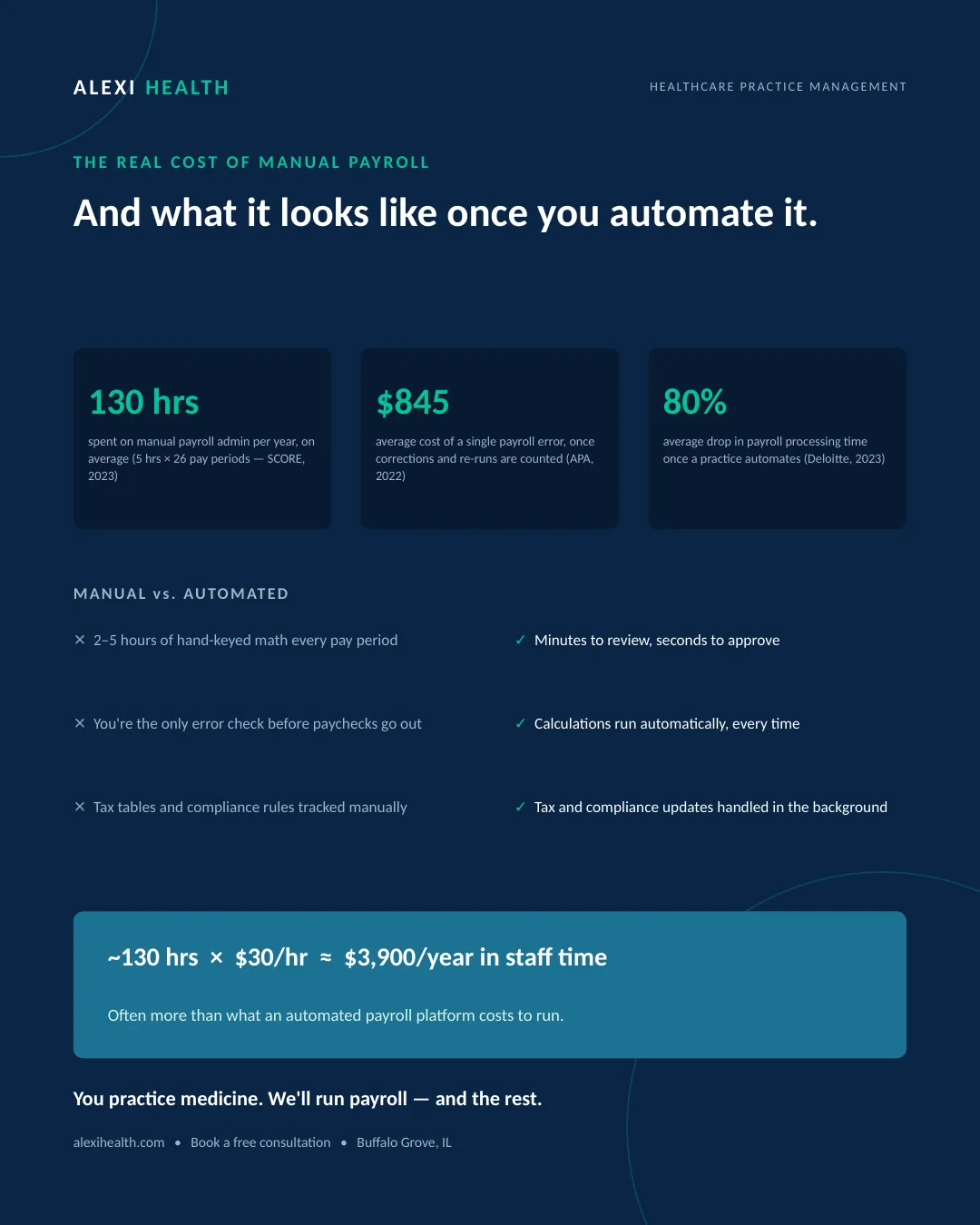
Small-business owners and office managers spend an average of about 5 hours per pay period on this work, according to SCORE’s 2023 research. For a practice running biweekly payroll, that’s roughly 130 hours a year — more than three full work-weeks — spent on administrative math instead of patients, staffing, or growing the practice.
And that estimate is conservative. It doesn’t include the time spent fixing mistakes after the fact — which, in healthcare practices juggling multiple pay rates, differentials, and PTO policies, happens more often than anyone would like.
Manual processes don’t just cost time — they cost accuracy. When a human is doing the math, a human is also the only thing standing between a correct paycheck and an expensive mistake.
The American Payroll Association puts the average cost of a single payroll error — once you factor in the correction, the re-run, and the staff time spent untangling it — at $845 per incident. That’s not a rare, worst-case number. It’s the average. A missed overtime calculation, a misapplied deduction, or a late tax filing can trigger that cost in minutes.
For an independent practice already operating on thin administrative margins, a handful of these errors a year adds up to real money — and real frustration for the staff who have to sort them out.
Automating payroll doesn’t mean losing visibility or control — it means moving the busywork off your team’s plate while keeping a dashboard view of everything that matters.
| Manual | Automated |
|---|---|
| 2–5 hours of hand-keyed math every pay period | Minutes to review, seconds to approve |
| You’re the only error check before paychecks go out | Calculations run automatically, every time |
| Tax tables and compliance rules tracked manually | Tax and compliance updates handled in the background |
The shift isn’t dramatic on the surface — payroll still runs every two weeks, staff still get paid on time — but underneath, the process goes from “a person doing arithmetic under time pressure” to “a system running the same validated calculation every time.” That’s where both the time savings and the error reduction come from.
Across practices and small businesses that make the switch, Deloitte’s 2023 Global Payroll Benchmarking Survey found an average 80% reduction in payroll processing time. That’s not a marginal improvement — it’s the difference between payroll being a recurring administrative burden and payroll being a five-minute review.
For a practice, that reclaimed time isn’t abstract. It’s the office manager who can spend an afternoon on patient scheduling instead of timesheets. It’s the physician-owner who isn’t pulled into payroll questions during clinic hours. It’s hours that go back to the parts of the practice that actually need a human’s judgment.
Here’s the simplest way to see whether automating pays for itself: compare the value of the staff time it currently takes against what a modern payroll platform costs to run.
Using the numbers above — about 130 hours a year on manual payroll, valued conservatively at $30 an hour in loaded staff cost — that’s roughly $3,900 a year in staff time alone, before counting a single error.
In most practices, that figure already exceeds the cost of an automated payroll platform — meaning the switch isn’t really a new expense. It’s a reallocation of money you’re already spending, from manual admin work to a system that does it faster and more accurately. Your own numbers will vary based on pay frequency, staff cost, and practice size, but the direction of the math almost never changes.
Most independent practices weren’t built with a dedicated payroll or HR function — they were built around clinical care, with administrative systems added piecemeal as the practice grew. Payroll is often one of the last things to get modernized, not because it’s unimportant, but because nobody on staff was hired to fix it. It just gets absorbed into someone’s existing job, usually the office manager’s, on top of everything else they’re already doing.
That’s the pattern we see across the practices we work with: administrative debt that accumulates quietly until someone finally sits down and adds up the hours.

How Alexi Health handles this
We’re not consultants who hand over a recommendation and leave. Alexi Health runs the business side of independent healthcare practices directly — payroll and time management alongside revenue cycle, credentialing, payer contracts, staffing, technology, and facilities. Sixteen disciplines, one operating partner, so a decision in payroll doesn’t create a blind spot somewhere else in the practice.
For payroll specifically, that means we implement and manage the automated systems, handle the transition from whatever manual process you’re using now, and keep it running — so your team gets the hours back without having to become payroll experts themselves.
If you want to see what this looks like for your specific practice — your pay frequency, your staff size, your current process — book a free consultation. We’ll look at where your payroll process is leaking time and tell you plainly what automating it would save.
Sources: SCORE (2023); American Payroll Association (2022); Deloitte, 2023 Global Payroll Benchmarking Survey. Staff-time figures are illustrative and will vary by practice.